Heading to IASS 2026 in Turin
Next week I’ll be attending IASS 2026 in Turin. I’m looking forward to a busy week.
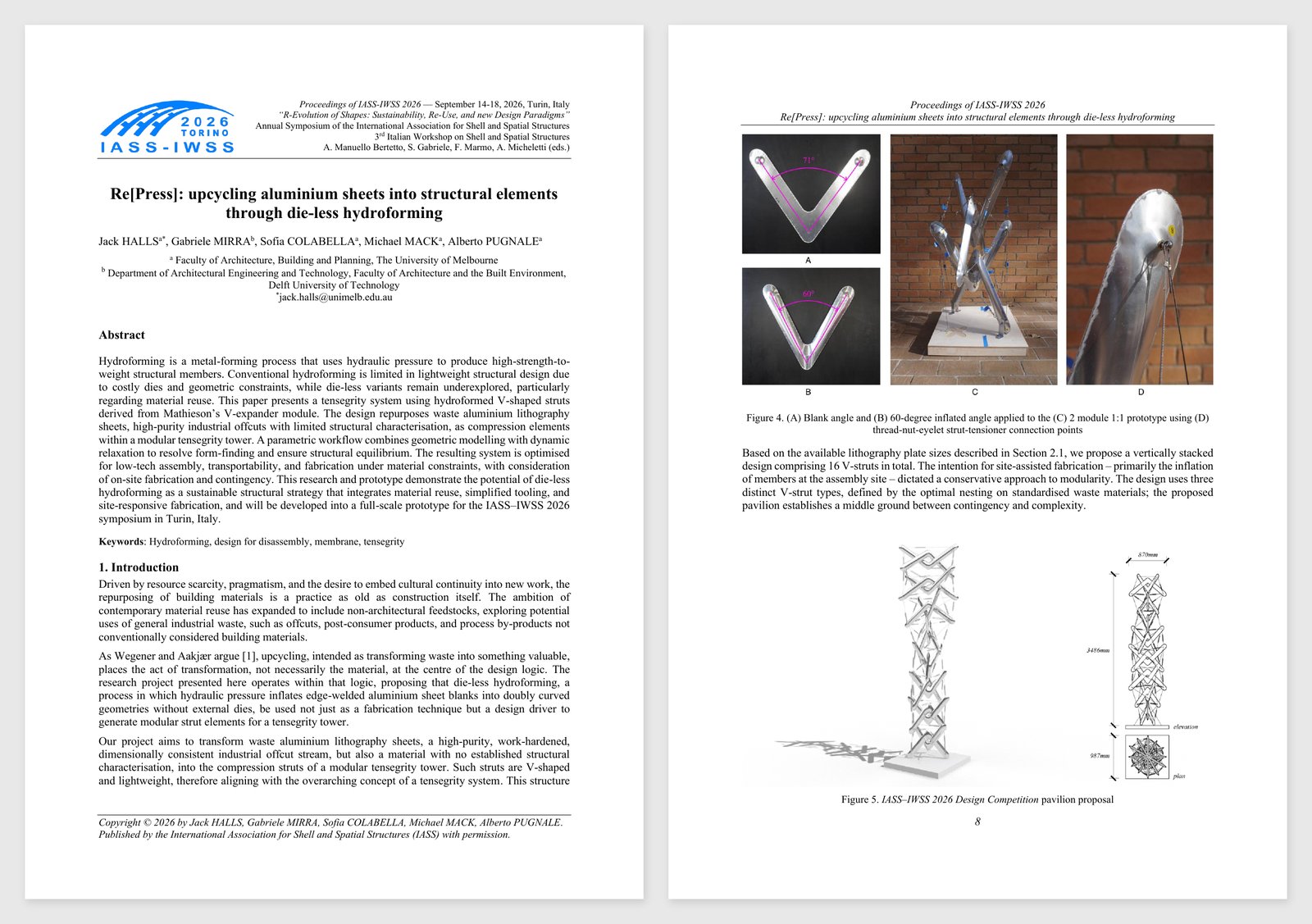
Together with Jack Halls, Sofia Colabella, Michael Mack and Alberto Pugnale, I’ll be participating in the IASS Design Competition with [Re]Press, a tensegrity structure made from reclaimed aluminium lithography sheets and developed using die-less hydroforming. The pavilion will be exhibited throughout the conference, while the associated paper, “[Re]Press: upcycling aluminium sheets into structural elements through die-less hydroforming,” will be presented on Monday by Jack Halls. The paper presents the design and assembly process, highlighting the computational and fabrication challenges involved and possible future developments of the system.
Two more papers related to my recent research activities will be presented on Thursday.
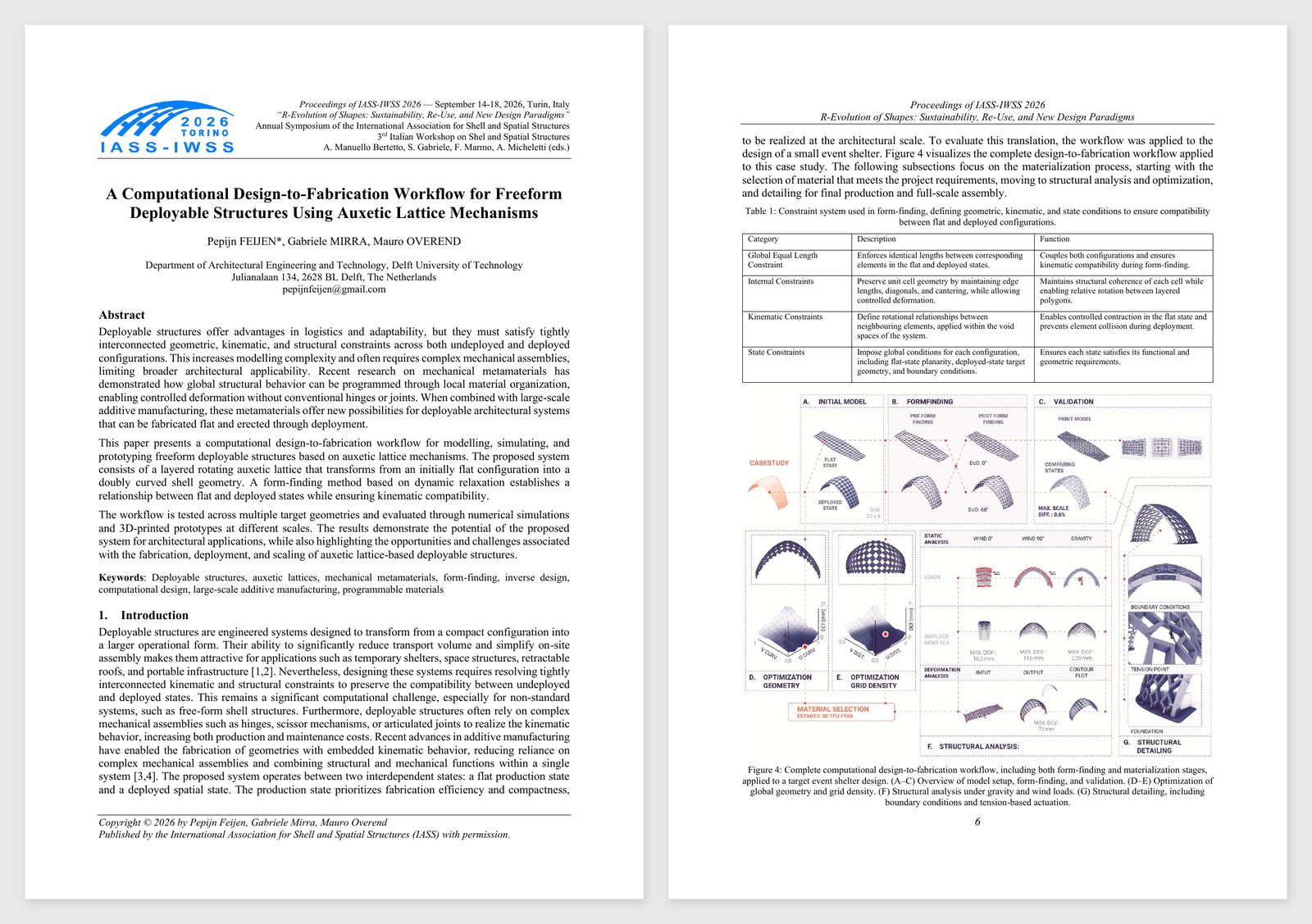
Pepijn Feijen will present “A Computational Design-to-Fabrication Workflow for Freeform Deployable Structures Using Auxetic Lattice Mechanisms,” developed as part of his graduation project in the Building Technology track at TU Delft, which I supervised together with Mauro Overend. The research presents a computational workflow for the design and fabrication of freeform deployable shells based on auxetic mechanisms and a fully 3D-printed system.
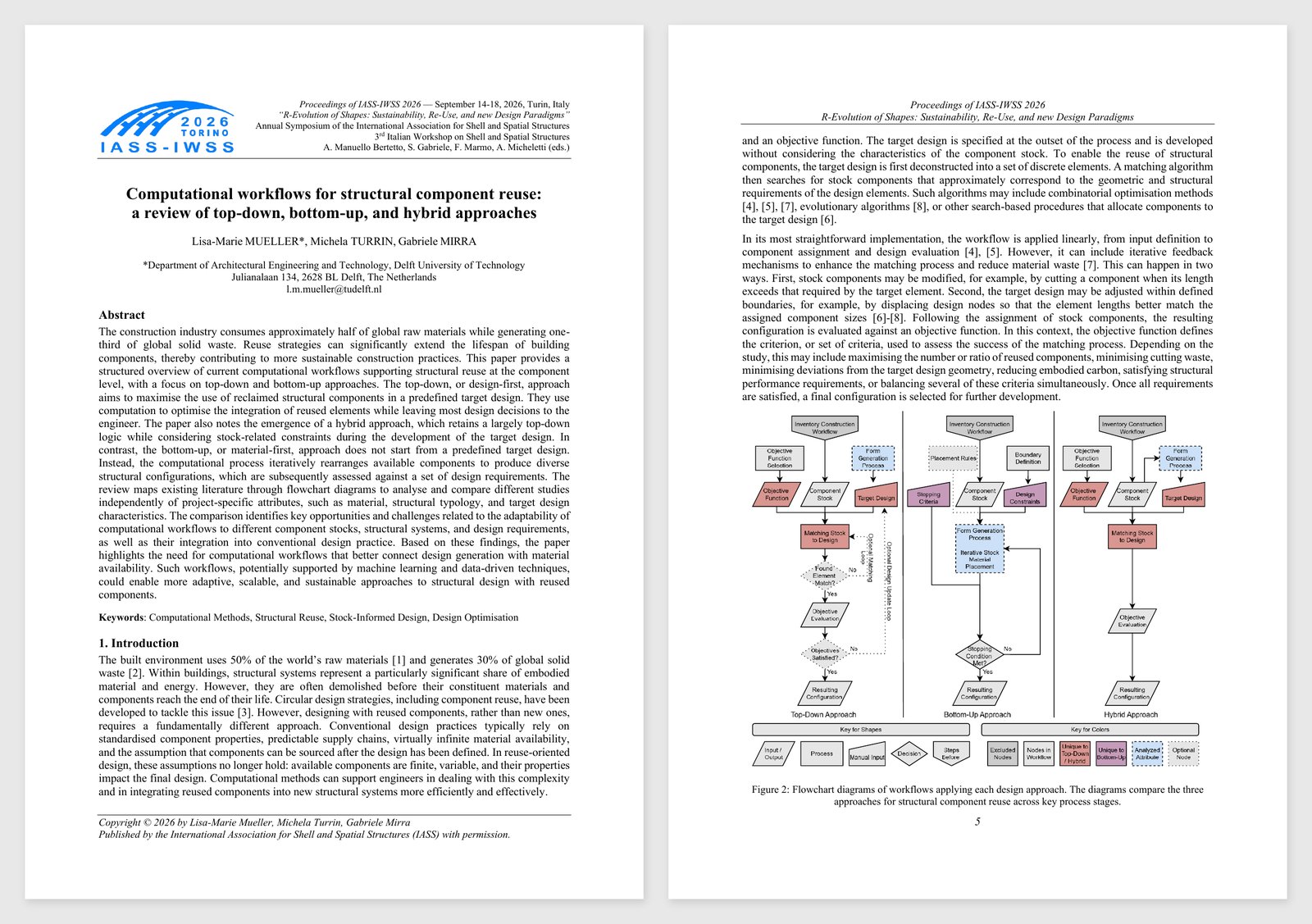
Lisa-Marie Mueller will present “Computational workflows for structural component reuse: a review of top-down, bottom-up, and hybrid approaches,” co-authored with Michela Turrin and me. The paper critically reviews existing computational workflows for structural component reuse, mapping current approaches and identifying open challenges and opportunities for future research.
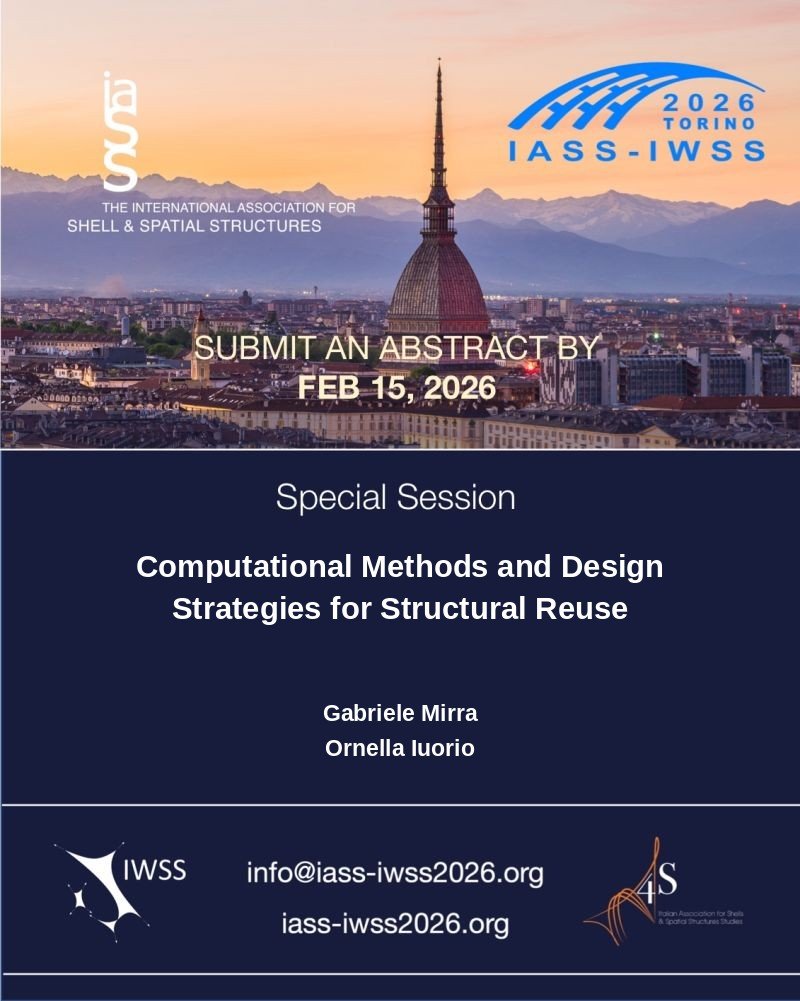
Finally, together with Ornella Iuorio, I’ll be chairing the new special session “Computational Methods and Design Strategies for Structural Reuse.” Running across Wednesday and Thursday, the session brings together different computational methods and design strategies for structural reuse, covering different materials and structural typologies and approaches ranging from optimisation and computational design to AI-based methods.
I’m looking forward to discussing this work at the conference and to catching up with colleagues and friends in Turin. If you’re attending, I hope to see you there!